 6 Nov 25
A look inside how we go from a one-line brief to finished, on-brand ad creative using AI, and the human checkpoints that keep the machine's speed from becoming the machine's mediocrity.
People imagine AI ad creation as a single step: type a prompt, get an ad. That is not how good work happens, and teams that treat it that way produce exactly the flood of forgettable, average creative that gives AI creative a bad name. The prompt is one stage in a pipeline, and the stages around it, the ones before and after the machine runs, are where the quality actually comes from.
Here is the honest pipeline we use to go from a one-line brief to finished, on-brand ad creative, and where the humans sit in it.
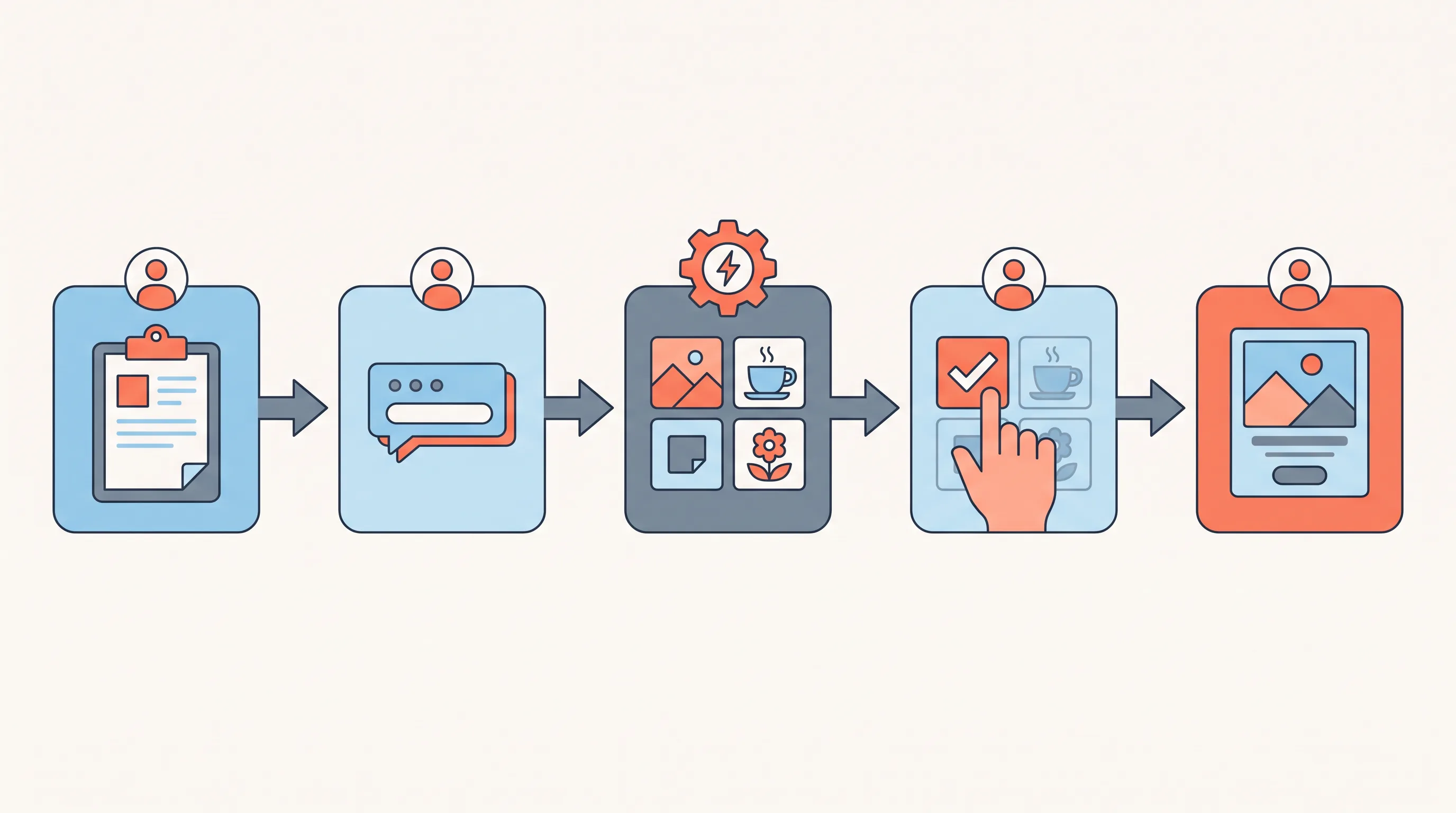
Stage 1: The Brief (Human)
Everything starts before any prompt is typed, with a decision about what this creative needs to do. Who is it for? What is the one message? What feeling should it carry, and what must it avoid? This is the stage that most determines the outcome, and the machine plays no part in it. A designer decides the concept, the emotional temperature, the brand line that must not be crossed. A great brief and a vague brief produce different universes, no matter how good the tools downstream, because the deciding is the part the machine cannot do.
Stage 2: The Prompt (Human, Informed by Craft)
Only now does the prompt get written, and it is a craft skill, not a wish. A designer’s prompt encodes the decisions from the brief: the composition logic, the palette, the mood, the exclusions, the things to keep out of frame. A novice types “make an ad for our app” and gets soup. A practitioner writes a prompt that already knows what it is looking for. The difference between those two prompts is the difference between the whole pipeline working and not, and it is a learned skill, the same way a shared prompt vocabulary is something a team builds over time.
Stage 3: Generation and Variants (Machine)
This is the stage everyone thinks is the whole thing, and it is genuinely the easy part now. The machine produces volume: many variations on the concept, alternates, options to react to. This is where AI earns its keep, because producing forty on-concept variations used to take days and now takes minutes. The machine is fast, tireless, and completely without judgement, which is exactly why it is bracketed by human stages on both sides.
Stage 4: Selection and Judgement (Human)
Now the most underrated stage: killing most of what the machine made. We routinely discard seventy to eighty percent of outputs, keeping only what is genuinely on-brand and genuinely good. The gap between “this is fine” and “this is us” is invisible to anyone who has not trained their eye for years, and closing it is the entire value a designer adds at this point. Volume without this filter is just a faster way to publish mediocrity. This is also where a testing framework picks up, so the selected variants are structured to actually teach you something once they run.
Stage 5: Finishing and Brand-Fit (Human, with Tools)
The selected creative is rarely finished. It gets the final craft pass: the exact crop, the typographic layer, the brand elements locked into place, the small corrections that separate professional from nearly-professional. The machine assists here, but a person owns the result, because the last five percent of polish is what a brand is judged on. Running this at volume without brand decay is exactly what a design system underneath the automation makes possible.
Where Teams Get This Wrong
Almost every failure we see with AI creative traces back to collapsing this pipeline into one step. A team hears “AI makes ads now,” types a prompt, takes the first plausible output, and ships it. No brief, so the creative is aimed at nothing in particular. No crafted prompt, so the machine defaults to the statistical average of everything it has seen. No selection, so the first output wins by accident rather than merit. No finishing, so it looks nearly-professional in the way that quietly tells customers you did not care. Five stages compressed into one, and the result is exactly the generic AI creative that makes people distrust the whole category.
The irony is that compressing the pipeline does not even save much time. The generation stage, the one people skip everything else to get to, was already the fast part. What they cut to save minutes is the judgement, which is the only part that was creating value. So they trade away the entire benefit to save time that was not the bottleneck. Speed was never the problem AI solved for creative; production was. Keep all five stages and you get production speed with the quality intact. Collapse them and you get speed with nothing worth shipping.
Why the Human Bookends Matter
Notice the shape of the pipeline: human, human, machine, human, human. The machine sits in the middle, doing the one thing it is extraordinary at, producing volume, and it is surrounded on every side by human judgement. Remove the front stages and you get technically-competent creative aimed at nothing. Remove the back stages and you get a flood of average outputs nobody curated. The AI did not replace the designer; it moved the designer’s work to the two ends of the pipeline, deciding what to make and judging what came out, and made both of those more consequential than before.
That is the honest version of “AI ad creation.” Not a prompt that spits out a finished ad, but a pipeline where the machine’s speed is harnessed by human taste at both ends. Get that shape right and you produce distinctive work at volume. Get it wrong, prompt in the middle and nothing else, and you produce the sea of sameness everyone is tired of.
If you want a prompt-to-ad pipeline built for your brand, with the human checkpoints designed in, that is exactly the kind of system we build.